
Note: this is the first article of a three-part series.
- Rujak Center for Urban Studies leads the co-design process of adaptive livelihood strategies with coastal communities in Central Java.
- A central focus of this participatory research is co-designing bamboo rumpon (mussel cultivation device) to address land subsidence and water risks with the residents of Timbulsloko (Demak) and Tambakrejo (Semarang).
- The co-design process also addresses persistent challenges related to the construction of the device, including short lifespan, high capital costs, and gendered labor division.
Introduction
The areas of Semarang and Demak in the north part of Central Java are vulnerable to land subsidence caused by the climate crisis, changing local environmental and residential landscapes. Rising sea level and coastal abrasion have caused many residential areas and farmlands to be engulfed by water, forcing locals to adapt with an increasingly more challenging environmental and socioeconomic condition. This irreversible tidal flood has threatened the livelihood of locals: they have to shift from an agriculture-based economy to one which depends on fisheries and marine aquaculture. Meanwhile, houses which used to stand strong now have to be elevated, or even abandoned, creating a sinking village which has changed the face of the area drastically.
The issue of land subsidence is deeply intertwined with water risks. Over-extraction of groundwater and the weight of urban development are the two most significant ‘structural’ causes of the sinking. They are also produced through a structure of inequality in terms of access to water and resources. The land subsidence is also causing – and in some cases, exacerbating – river and coastal flooding as well as abrasion. These consequences will have a more devastating impact on some than on others. We have to take these factors into account when discussing the protection of livelihood of residents in these sinking villages.
The Rujak Center for Urban Studies (RCUS) was part of a consortium studying this topic. The consortium also comprises the Soegijapranata Catholic University’s Environmental and Urban Studies Program, the Sultan Agung Islamic University’s Sustainable Development Research Center, the Indonesian Forum for the Environment’s (Wahana Lingkungan Hidup Indonesia/WALHI) Central Java chapter, the Indonesian Legal Foundation’s Semarang Chapter, the Amerta Air Indonesia foundation and the IHE-Delft Institute for water Education. The research study is called Pluralizing Knowledge on the Relations Between Water Risks and Land Subsidence: Knowledge Production, Organizing, and Campaign in Central Java, Indonesia.
As a member of the consortium, RCUS focuses on co-designing adaptive livelihood strategies with coastal communities in Timbulsloko (Demak) and Tambakrejo (Semarang). We strengthen the community to solve the recurring problems related to their use of bamboo rumpons to cultivate mussels as they shifted from an agriculture economy: short lifespan, high capital costs, and gendered labor divisions. This participatory study engages locals directly in designing a mussel cultivation structure that is more durable while bringing down costs as well as promoting gender parity in its operations.
The participatory aspect of this study seeks to fill the gap left by the hegemonic, technocratic and masculine/patriarchal knowledge systems of engineers from the Earth science disciplines (hydrogeology, geology, geodesy, geophysics and geography) in approaching and defining land subsidence.
This approach is hegemonic because it is amplified and campaigned by mainstream media as the only explanation for this problem. It is technocratic and masculine in a sense that the engineers’ solutions to land subsidence and water risks are centrally-governed big/giant infrastructure projects created through top-down processes. This study will instead take a bottom-up approach, intervening in the existing system of societal knowledge production and circulation to pluralize knowledge on said topic. RCUS has just finalized the first phase of this project. Here is an overview of the research process and its milestones.
Initial exploration through FGD and reding group
The program began with field assessments in February 2025, comprising field survey, observation and in-depth interview. Key findings include: only 30-40 percent of bamboo is reusable after one cycle and that women’s labor is concentrated in post-harvest cleaning; they are also excluded from technical and cooperative decision-making.
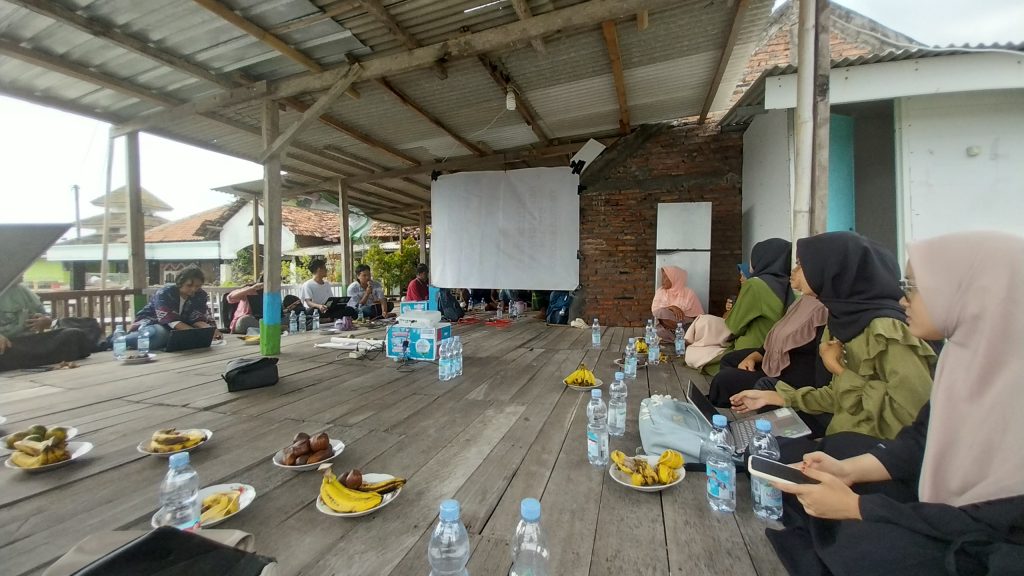
Then in April 2025, we conducted focus group discussions (FGDs) joined by residents from three villages: Timbulsloko, Tambakrejo, Mangkang, through which we mapped the gender dimensions of the tidal flooding and consequent shifting livelihoods. RCUS then presented its assessment findings to locals, initiating discussions and bamboo preservation and the strengthening of local cooperatives.
Then, in May and June 2026, RCUS actively designed and participated in the consortium’s reading group on co-design in coastal areas, discussing research studies to produce a structured analysis, linking theory to practice. Through this process, we agreed that co-design must move beyond improving techniques (durability, design) toward gender mainstreaming and structural change, recognizing conflicts, inequalities, and institutional power relations as central to resilience.
Through the reading group, Rujak concluded and contributed a critical reframing of rumpon beyond a purely technical or livelihood intervention. The discussions highlighted that coastal production systems such as rumpon are embedded within wider social and ecological relations. The economy of shellfish cultivation depends not only on bamboo and sea currents, but also on forms of labor and environmental resources that remain unrecognized. Women’s post-harvest cleaning work, household management, and care responsibilities sustain the production cycle, yet these contributions are rarely included in profit calculations or reflected in cooperative governance structures. This finding underscores that economic sustainability must begin with acknowledging invisible labor and redistributing recognition and decision-making power. It is also related to the gender dimension mentioned above.
The reading group also affirmed that local ecological knowledge constitutes legitimate and sophisticated expertise. Residents possess detailed understanding of bamboo species, seasonal cycles, tidal movements, and shellfish growth patterns. Rather than treating this knowledge as informal or secondary to technical science, Rujak positioned co-design and experimentation as mechanisms to elevate and formalize community-based knowledge. This contribution challenges dominant development approaches that privilege external expertise, and instead promotes pluralized knowledge production rooted in lived experience.
A further conclusion concerns other aspects of gender inequality across the rumpon value chain. Men predominantly control construction, technical decisions, and cooperative leadership, while women’s involvement remains concentrated in post-harvest and informal activities. The reading group identified this imbalance not as incidental but as structural, shaped by access to capital, training, and institutional participation. Addressing rumpon durability or productivity without addressing gendered power relations would therefore reproduce existing inequalities. Rujak’s contribution lies in articulating a gender-transformative pathway that integrates capacity strengthening, inclusive cooperative governance, and recognition of reproductive labor into technical innovation.
Finally, the reading group situated rumpon within a broader social ecological system shaped by climate risk, land subsidence, and economic precarity. Livelihood strategies are creative but fragile, relying on affordable bamboo, favorable weather, and unstable market conditions. The conclusion is that improving bamboo design alone is insufficient. Sustainable transformation requires strengthening local institutions, expanding economic literacy, and embedding adaptation strategies within cooperative frameworks. In this sense, the reading group provided the conceptual foundation that links technical experimentation with institutional reform and social justice.
The initial findings from the FGD and reading group served as Rujak’s foundation to experiment and co-design a more financially efficient rumpon with locals, which will be elaborated in more detail in the second part of this article.
